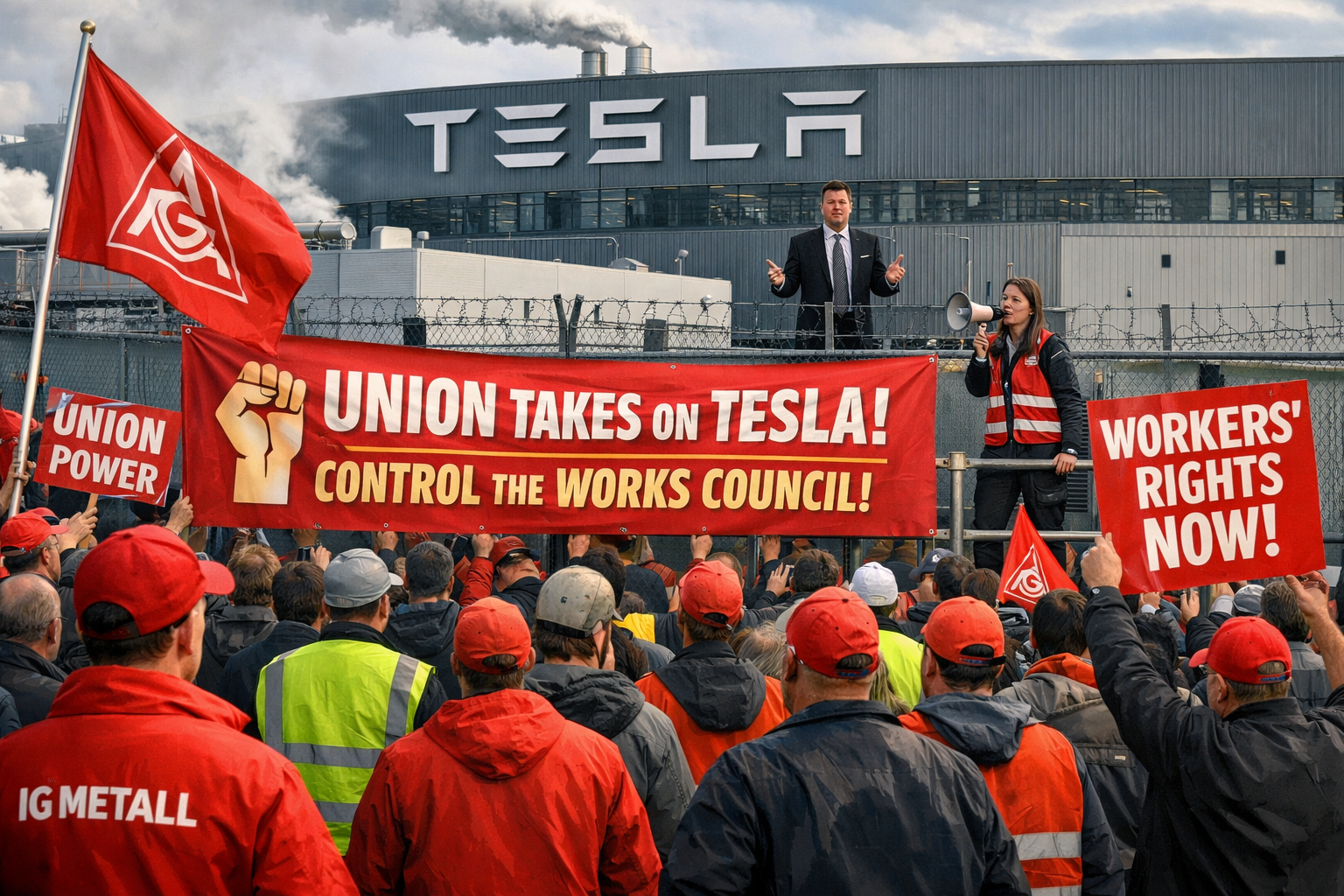
A major labour conflict is unfolding at Tesla’s Gigafactory in Germany, where Europe’s largest trade union is attempting to gain influence over the factory’s works council. The dispute has escalated into a tense standoff between the powerful union IG Metall and Tesla’s leadership, led by CEO Elon Musk.
The conflict involves lawsuits, accusations of slander and deep disagreements over working conditions and labour rights at Tesla’s manufacturing plant near Berlin.
Works Councils and Their Role in Germany
In Germany, works councils are elected employee groups that represent workers in negotiations with company management. They play a key role in discussions about workplace matters such as:
- Working hours
- Employee benefits
- Salary agreements
- Workplace safety and conditions
Works councils are a well-established part of the German business system, especially in the automotive sector where employee representation has traditionally been strong.
Tesla’s Gigafactory in Grünheide
Tesla’s manufacturing facility in Grünheide, located about 30 km southeast of Berlin, is the company’s only production plant in Europe.
The factory employs around 10,000 workers and produces electric vehicles for the European market.
However, tensions between management and labor representatives have existed since before the factory officially opened nearly four years ago.
Observers say the disagreements reflect a broader clash between Tesla’s fast-paced corporate style and Germany’s traditional “social market economy,” which strongly emphasizes worker participation and collective bargaining.
Election Battle for the Works Council
Elections for the factory’s works council have begun, with voting scheduled to take place from Monday through Wednesday.
Currently, the council is controlled by representatives who are not affiliated with trade unions. IG Metall is now attempting to gain a majority by nominating a large number of candidates.
The union has put forward 116 candidates, hoping to secure at least 19 of the 37 seats required for a simple majority.
In the previous election two years ago, the union won 16 seats when the council had 39 members.
Dispute Over Working Conditions
IG Metall argues that Tesla employees face demanding workloads and that some workers have been dismissed after being accused of poor performance.
The union believes that a formal collective agreement is necessary to ensure better protection for workers.
Tesla rejects these allegations and insists that it offers competitive pay and good working conditions. According to the company, the union’s main goal is simply to expand its membership among Tesla employees.
Legal Tensions Escalate
The dispute intensified recently after Tesla accused a union member of secretly recording a works council meeting, which would violate internal rules.
IG Metall denied the accusation, calling it unfounded. Both sides have taken legal action against each other over the matter, adding further strain to an already tense situation.
Government Calls for Dialogue
Officials in the state of Brandenburg, where the factory is located, have been asked to intervene in the dispute.
However, the regional economics ministry has encouraged Tesla and the union to resolve the issue themselves while also suggesting that the company consider adopting a collective labour agreement.
Pressure on Tesla in Europe
The ongoing dispute has created additional challenges for Tesla as the company faces declining sales in Europe due to growing competition from lower-priced electric vehicles produced by Chinese manufacturers.
In Germany, public criticism of Musk has also increased after his support for the far-right political party Alternative für Deutschland, which has sparked consumer backlash among some buyers.
What Happens Next?
The results of the works council election could significantly shape labour relations at Tesla’s German factory in the coming years.
If IG Metall gains control of the council, it may push for stronger collective bargaining agreements and increased worker protections. If not, Tesla’s management may continue operating with its current workplace policies.
Either way, the outcome is likely to influence the future of Tesla’s operations in Europe and the broader debate about labour rights in the electric vehicle industry.
About the Author