
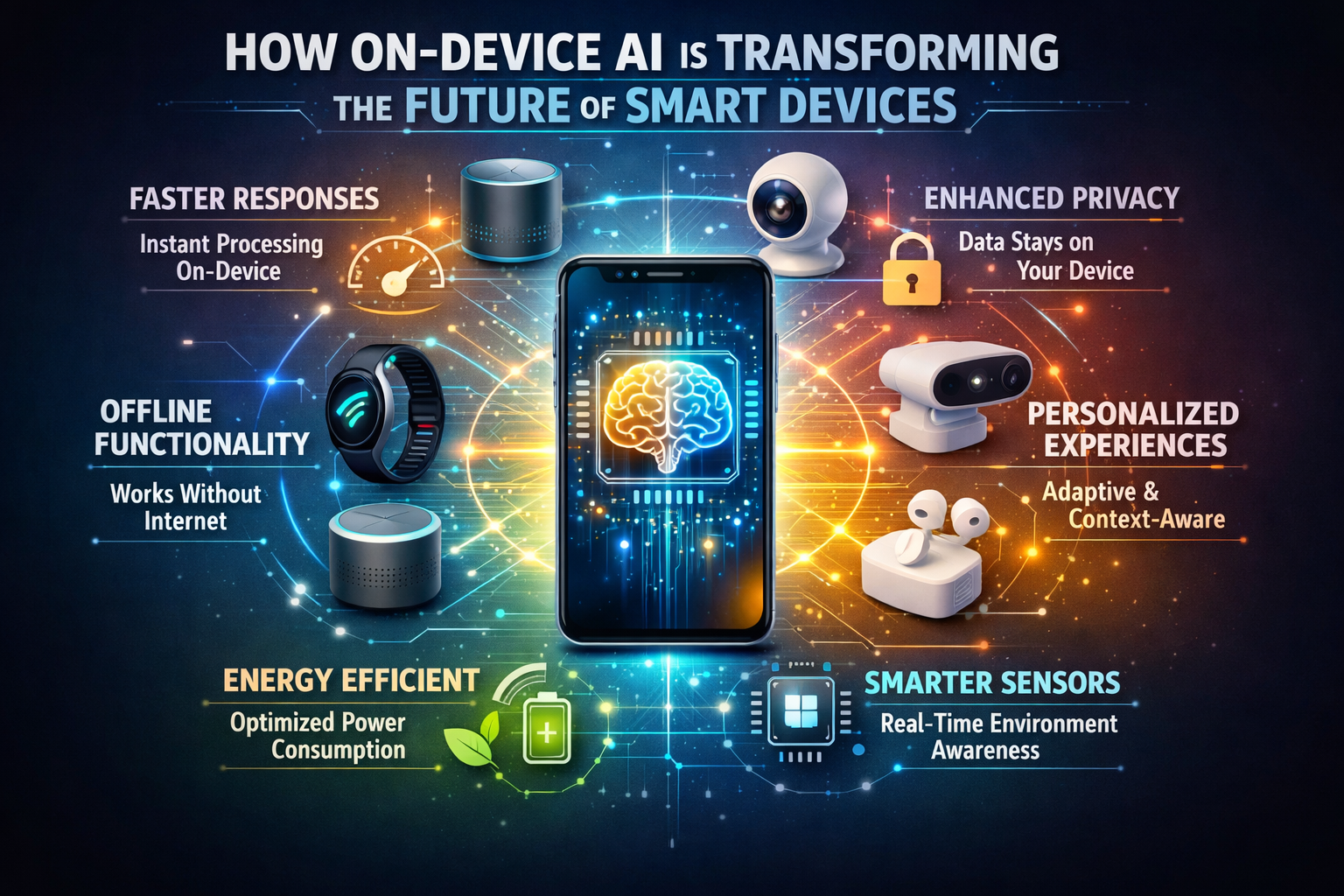
Artificial Intelligence (AI) has rapidly evolved from a cloud-dependent technology to something far more accessible and efficient—on-device AI. Instead of relying on remote servers to process data, modern devices like smartphones, laptops, and wearables are now capable of running AI models locally. This shift is transforming how users interact with technology, making experiences faster, more secure, and highly personalized.
What is On-Device AI?
On-device AI refers to artificial intelligence processes that are executed directly on a user’s device rather than being sent to and processed in the cloud.
How It Works
Traditional AI systems rely on cloud servers to analyze data and send results back to the user. In contrast, on-device AI uses built-in hardware components such as Neural Processing Units (NPUs), GPUs, or optimized CPUs to perform computations locally.
Key Components
- Dedicated AI chips (NPUs)
- Efficient machine learning models
- Edge computing frameworks
Why It Matters
This shift reduces dependency on internet connectivity and enables real-time processing.
Quick Summary
On-device AI = Local processing + Faster response + Better privacy
Why On-Device AI is Gaining Popularity
The rapid growth of on-device AI is driven by several technological and user-centric factors.
Speed and Performance
One of the biggest advantages is speed. Since data doesn’t need to travel to the cloud, responses are nearly instant.
Real-Time Applications
- Voice assistants responding instantly
- Camera enhancements in real time
- Live language translation
Reduced Latency
Lower latency leads to smoother and more responsive user experiences.
Bottom Line
Faster processing makes everyday tech interactions seamless.
Enhanced Privacy and Security
Privacy concerns have become a major issue in the digital age. On-device AI directly addresses these concerns.
Data Stays Local
When AI processing happens on your device, sensitive data doesn’t need to be uploaded to external servers.
Examples of Private Data
- Personal photos
- Voice recordings
- Health information
Security Benefits
- Lower risk of data breaches
- Reduced exposure to third-party tracking
Key Takeaway
On-device AI gives users more control over their personal information.
Offline Functionality and Accessibility
Another major benefit is the ability to function without a constant internet connection.
No Internet? No problem.
On-device AI allows features to work even in offline environments.
Practical Use Cases
- Navigation in remote areas
- Offline voice commands
- Text prediction without internet
Global Impact
This is especially beneficial in regions with limited or unreliable connectivity.
Conclusion
On-device AI expands access to smart technology worldwide.
Everyday Applications of On-Device AI
On-device AI is already integrated into many devices and applications we use daily.
Smartphones
Modern smartphones use AI for photography, battery optimization, and voice recognition.
Examples
- Face unlock
- Smart photo editing
- Predictive typing
Wearables
Devices like smartwatches use AI for health tracking and activity monitoring.
Smart Living
AI-powered home devices are becoming more responsive and efficient.
Challenges and Limitations
Despite its advantages, on-device AI still faces certain challenges.
Hardware Limitations
Not all devices are equipped with advanced processors required for AI tasks.
Power Consumption
Running AI locally can consume more battery if not optimized properly.
Model Size Constraints
AI models must be smaller and more efficient to run on devices.
Ongoing Improvements
Tech companies are continuously working to overcome these limitations.
The Future of On-Device AI
The future looks promising as technology continues to advance.
Smarter Devices Ahead
With improvements in chip design and machine learning models, devices will become even more capable.
Integration with Emerging Tech
- Augmented Reality (AR)
- Virtual Reality (VR)
- Internet of Things (IoT)
Personalized Experiences
AI will adapt more closely to individual user behavior and preferences.
Final Thought
On-device AI is set to become a standard feature in all smart devices.
Conclusion
The rise of on-device AI marks a significant shift in how technology operates and interacts with users. By bringing intelligence directly to devices, it offers faster performance, enhanced privacy, and greater accessibility. While challenges remain, ongoing advancements are quickly closing the gap.
As more companies adopt this approach, on-device AI will redefine the future of digital experiences—making them smarter, safer, and more efficient than ever before.
About the Author