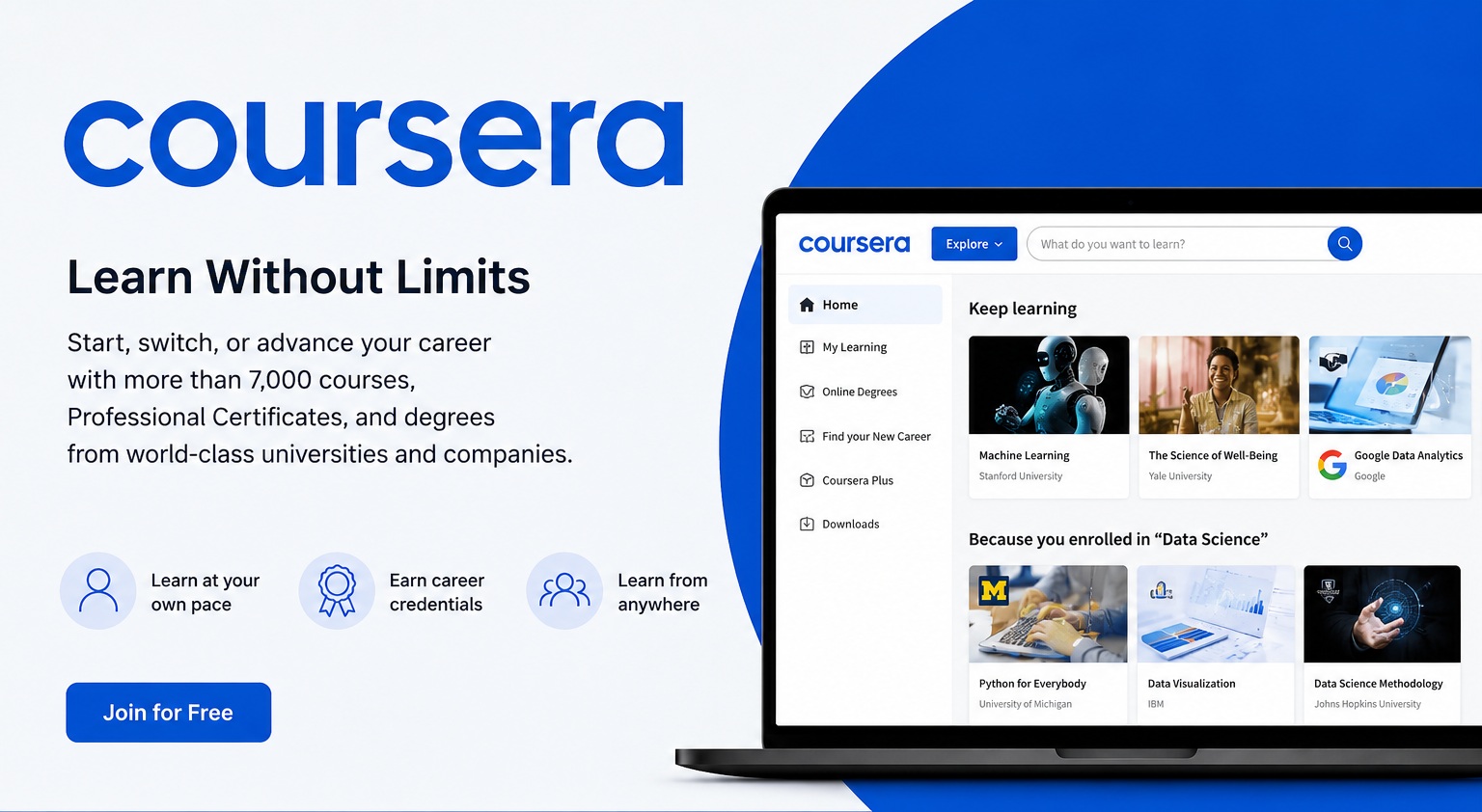
When Andrew Ng and Daphne Koller launched Coursera in 2012, their goal was simple but ambitious: make world-class education accessible to anyone with an internet connection. More than a decade later, Coursera has evolved from a startup offering free university courses into one of the world’s largest online learning ecosystems, serving millions of learners, businesses, and governments worldwide.
Today, Coursera stands at the center of the global digital education industry, driven by artificial intelligence, career-focused certifications, and enterprise workforce training.
The Early Vision: Education Without Borders
Coursera began during the rise of MOOCs (Massive Open Online Courses). The platform partnered with elite universities to provide online versions of academic courses that were previously available only on campus.
Unlike traditional education systems limited by geography and cost, Coursera introduced a flexible learning model where anyone could learn from institutions such as Stanford University, Yale University, and University of Michigan.
This approach helped Coursera attract millions of learners during its early years and positioned it as a pioneer in digital education.
Expansion Beyond Universities
As online learning matured, Coursera realized that learners were increasingly focused on employable skills rather than traditional academic theory alone.
The company expanded beyond university courses by partnering with major technology firms including Google, IBM, Meta, and Microsoft to create industry-recognized professional certificates.
These programs became especially popular because they offered practical, job-oriented training in areas such as:
- Data science
- Cybersecurity
- Cloud computing
- Artificial intelligence
- Digital marketing
- Project management
The shift toward career-focused learning helped Coursera compete more effectively in the growing EdTech market.
The Pandemic Accelerated Global Adoption
The global transition to remote work and online education during the COVID-19 pandemic dramatically accelerated Coursera’s growth.
Universities, companies, and governments urgently needed scalable digital learning platforms. Coursera responded by expanding free access initiatives and enterprise learning solutions.
During this period, millions of new users joined the platform, helping online learning become mainstream rather than alternative education.
The company later went public on the NYSE: COUR, further strengthening its global visibility.
AI Became Coursera’s Biggest Growth Driver
In recent years, artificial intelligence has transformed Coursera’s strategy.
The platform introduced several AI-powered features including:
- Personalized learning recommendations
- AI tutoring and coaching tools
- Role-play simulations
- AI-assisted course creation
- Skills-based career pathways
Coursera also partnered with leading AI companies such as OpenAI and Anthropic to expand AI education offerings.
According to Coursera’s 2025 financial reports, demand for AI courses surged rapidly as professionals worldwide rushed to learn generative AI skills.
One major example was the launch of new AI certificate programs with Google, which included practical training using tools like Gemini and Notebook.
Enterprise Learning Fueled Business Growth
Coursera’s expansion into enterprise and government learning became another major milestone.
The company developed solutions for:
- Corporate workforce upskilling
- Employee reskilling programs
- Government digital transformation initiatives
- University learning management systems
By the end of 2025, Coursera reported more than 1,700 paid enterprise customers globally and nearly 197 million registered learners.
Its enterprise segment continued generating strong recurring revenue as companies invested heavily in AI and technology training.
The Planned Udemy Merger
One of the biggest recent developments was Coursera’s announced acquisition of Udemy in a deal valued at approximately $2.5 billion.
The merger reflects a broader trend of consolidation in the online learning industry as platforms compete to dominate the fast-growing AI reskilling market.
The combined company aims to merge:
- Coursera’s university and enterprise strengths
- Udemy’s instructor marketplace model
- AI-powered personalized learning tools
Industry analysts believe this could create one of the largest digital education ecosystems globally.
Financial Growth and Market Position
Coursera’s financial performance in 2025 highlighted its growing scale:
- Full-year revenue reached approximately $757 million
- Revenue grew around 9–10% year-over-year
- Consumer and enterprise segments both expanded
- Free cash flow and operating performance improved significantly
The company also strengthened its position as a leading AI-focused learning platform by integrating AI-native learning experiences directly into its ecosystem.
Challenges Ahead
Despite its success, Coursera still faces important challenges:
- Increasing competition from AI-driven learning tools
- Questions about certificate credibility and learner assessment quality
- Pressure to maintain affordable pricing
- Competition from YouTube, ChatGPT, and free educational platforms
However, Coursera continues investing heavily in AI personalization, enterprise learning, and strategic partnerships to maintain long-term growth.
The Future of Coursera
Coursera’s evolution reflects a larger transformation happening across global education. Traditional degrees are no longer the only pathway to career advancement. Employers increasingly value practical, continuously updated skills — especially in AI and technology.
By combining university education, professional certifications, AI-powered learning, and enterprise workforce training, Coursera has positioned itself as more than just an online course platform. It is becoming a global digital learning infrastructure company.
As artificial intelligence reshapes industries and job markets worldwide, Coursera’s focus on scalable upskilling may become even more important in the years ahead.
About the Author