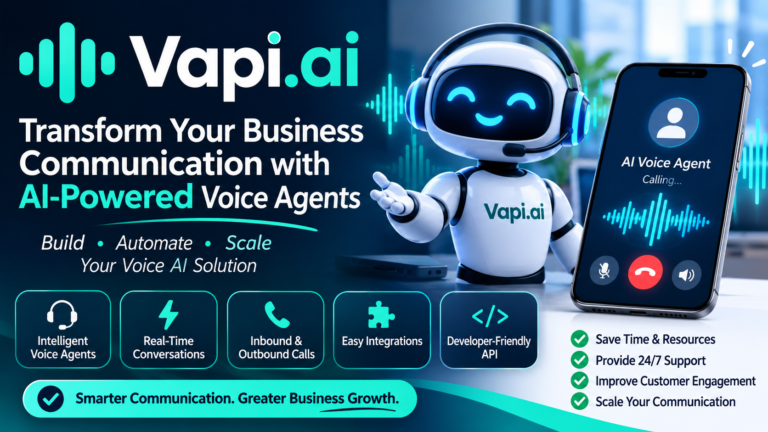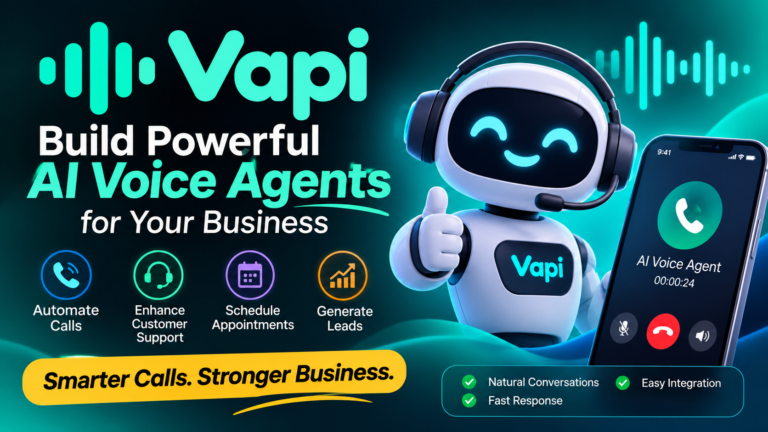

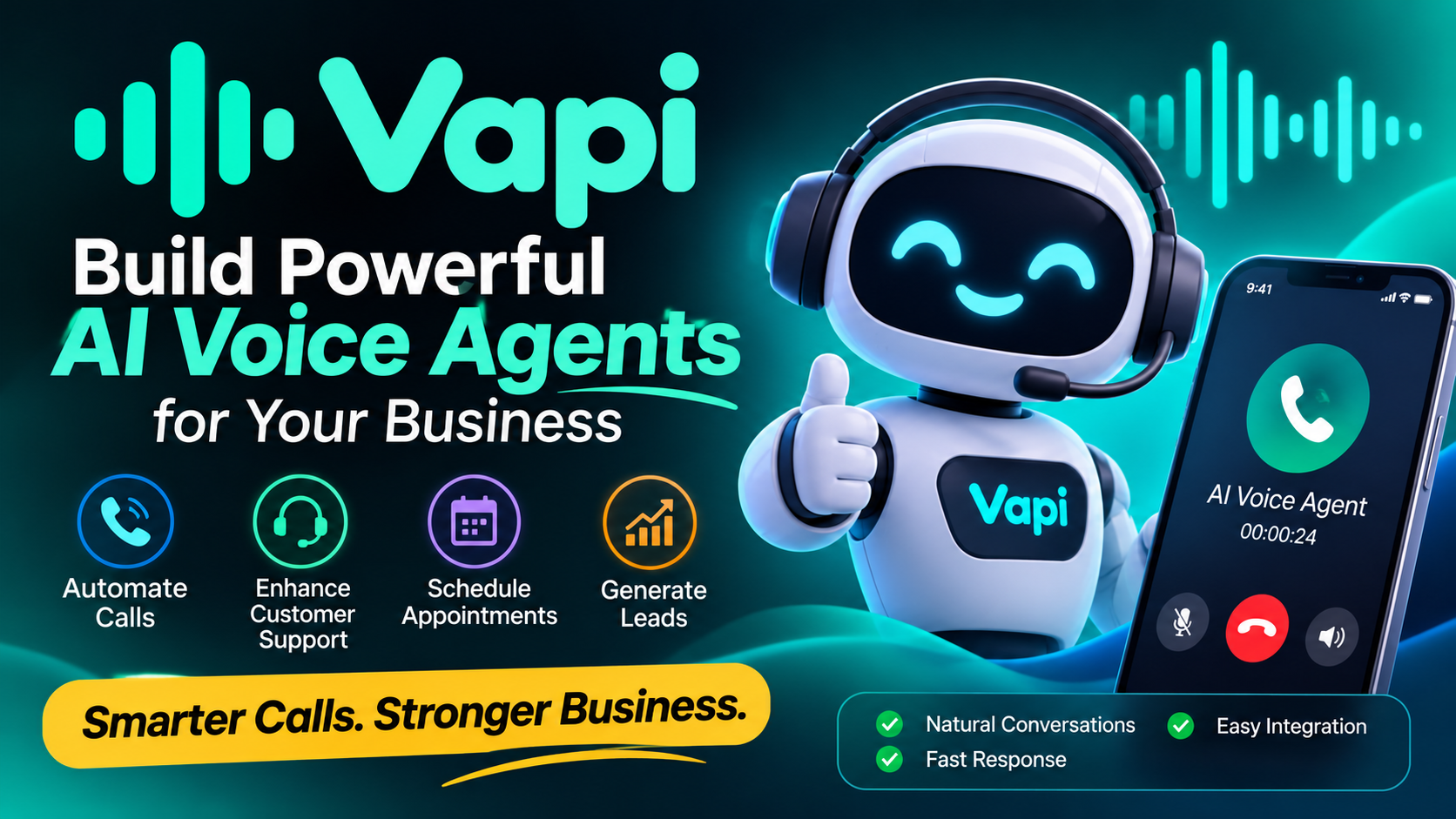
Artificial intelligence is transforming the way businesses communicate with customers. From answering phone calls to scheduling appointments and handling customer support, AI-powered voice assistants are becoming an important part of modern business operations. Vapi is one platform helping developers and businesses build intelligent AI voice agents that can handle real-time conversations.
Whether you are a startup, software developer, agency, or established business, Vapi offers tools to create customized voice assistants without building an entire voice infrastructure from scratch.
In this Vapi review, we will explore its features, benefits, pricing, use cases, and why it could be a useful solution for businesses looking to automate phone-based communication.
What Is Vapi?
Vapi is a developer-focused AI voice platform that allows users to build, test, and deploy AI voice agents capable of making and receiving phone calls.
Unlike traditional automated phone systems, Vapi-powered voice agents can understand spoken questions, generate relevant responses, and interact with customers through natural conversations.
The platform combines speech-to-text technology, large language models (LLMs), and text-to-speech technology to create responsive voice experiences.
Businesses can use Vapi to automate customer service, qualify sales leads, schedule appointments, answer frequently asked questions, and manage other communication workflows.
Key Features of Vapi
1. Natural AI Voice Conversations
One of Vapi’s main advantages is its ability to support natural-sounding conversations. Its voice agents are designed to handle turn-taking, interruptions, and custom pronunciation.
This helps businesses create more engaging customer interactions compared with basic automated phone menus.
2. Inbound and Outbound Calling
Vapi supports both incoming and outgoing phone calls.
Businesses can configure AI agents to answer customer inquiries, follow up with potential customers, confirm appointments, and manage other phone-based tasks.
This flexibility makes it useful for companies that receive a high volume of calls or need to conduct regular outbound communication.
3. Multiple AI Model Integrations
Vapi gives developers flexibility when selecting the technologies behind their voice agents.
Users can choose from supported speech recognition, language model, and text-to-speech providers or connect their own models and API keys.
This modular approach makes it easier to customize voice agents according to specific business requirements.
4. Low-Latency Responses
Fast responses are essential for natural voice conversations. Long pauses can make automated calls feel frustrating and unnatural.
Vapi focuses on reducing response latency to create smoother real-time interactions. Its platform highlights response times under 500 milliseconds as a key capability.
Actual performance can vary depending on the selected models, network conditions, and configuration.
5. Custom Tools and API Integrations
Vapi allows voice agents to connect with external APIs and business applications.
For example, a customer support agent can retrieve information from a business database, check an order status, or trigger an action through an integrated service.
This makes Vapi more than a basic answering system. Developers can build voice agents that perform useful tasks during conversations.
6. Analytics, Testing, and Monitoring
Creating a voice agent is only the beginning. Businesses also need to understand how well it performs.
Vapi provides tools for testing, simulations, reporting, and monitoring conversations. Developers can review interactions, identify potential problems, and improve their agents over time.
How Can Businesses Use Vapi?
Vapi supports several practical business applications.
Customer Support: Automate common customer inquiries, provide information, and route complex requests to human representatives.
Appointment Scheduling: Build voice assistants that handle booking requests, check availability, and confirm appointments.
Lead Generation: Use outbound AI calls to qualify potential customers and collect relevant information.
E-commerce: Help customers with order tracking, product inquiries, returns, and other shopping-related questions.
Healthcare Administration: Create assistants for appointment scheduling and administrative communication, with appropriate privacy and compliance configurations.
Real Estate: Automate property inquiries, collect buyer requirements, and arrange viewing appointments.
These applications can help businesses manage repetitive communication while allowing employees to focus on more complex tasks.
Vapi Pricing: How Much Does It Cost?
Vapi offers a usage-based starting option along with paid success packages.
According to its official pricing page, the available options include:
- Free to Start: $0 upfront, with $5 in free credits and usage-based charges.
- Core: $29 per month.
- Pro: 10% of Vapi hosting fees, with a $999 monthly minimum.
- Premier: Custom pricing for larger organizations.
The no-success-package option includes Vapi hosting at $0.05 per minute, while transcription, language models, voice generation, and certain telephony services can have additional costs.
Therefore, the total expense depends on call duration, selected providers, integrations, and usage.
Businesses should check the official Vapi pricing page before choosing a package because prices and plan details may change.
Benefits of Using Vapi
Here are some reasons businesses and developers may consider Vapi:
- Save Development Time: Build voice agents without creating an entire voice infrastructure from the beginning.
- Automate Repetitive Tasks: Handle common customer interactions automatically.
- Flexible Customization: Choose different models, voices, and integrations.
- Business Scalability: Build systems that can support growing call volumes.
- Improved Availability: Configure AI assistants to handle calls beyond normal business hours.
- Developer-Friendly Tools: Use APIs, SDKs, and customization options to build tailored voice experiences.
Is Vapi Worth Trying in 2026?
Vapi is worth exploring if you want to develop AI-powered phone assistants or add real-time voice capabilities to an existing application.
Its biggest strengths are its flexible architecture, model integrations, telephony controls, and ability to connect voice conversations with external business systems.
However, Vapi is primarily designed for developers and businesses that want control over their voice AI workflows. Beginners may need some technical knowledge to configure advanced integrations, prompts, and calling systems.
Before deploying an agent for real customers, it is important to test conversation quality, response accuracy, privacy settings, and operating costs.
Final Verdict
Vapi provides a flexible platform for building and managing AI voice agents for different business needs. Whether you want to automate customer support, manage appointment bookings, qualify leads, or create a voice-enabled application, its tools offer a practical starting point.
With customizable AI models, inbound and outbound calling, API integrations, and monitoring capabilities, Vapi is an interesting option for businesses looking to bring voice AI into their operations.
If you are interested in building smarter customer communication systems, explore Vapi and discover what you can create with AI voice technology.
About the Author